Table of Contents
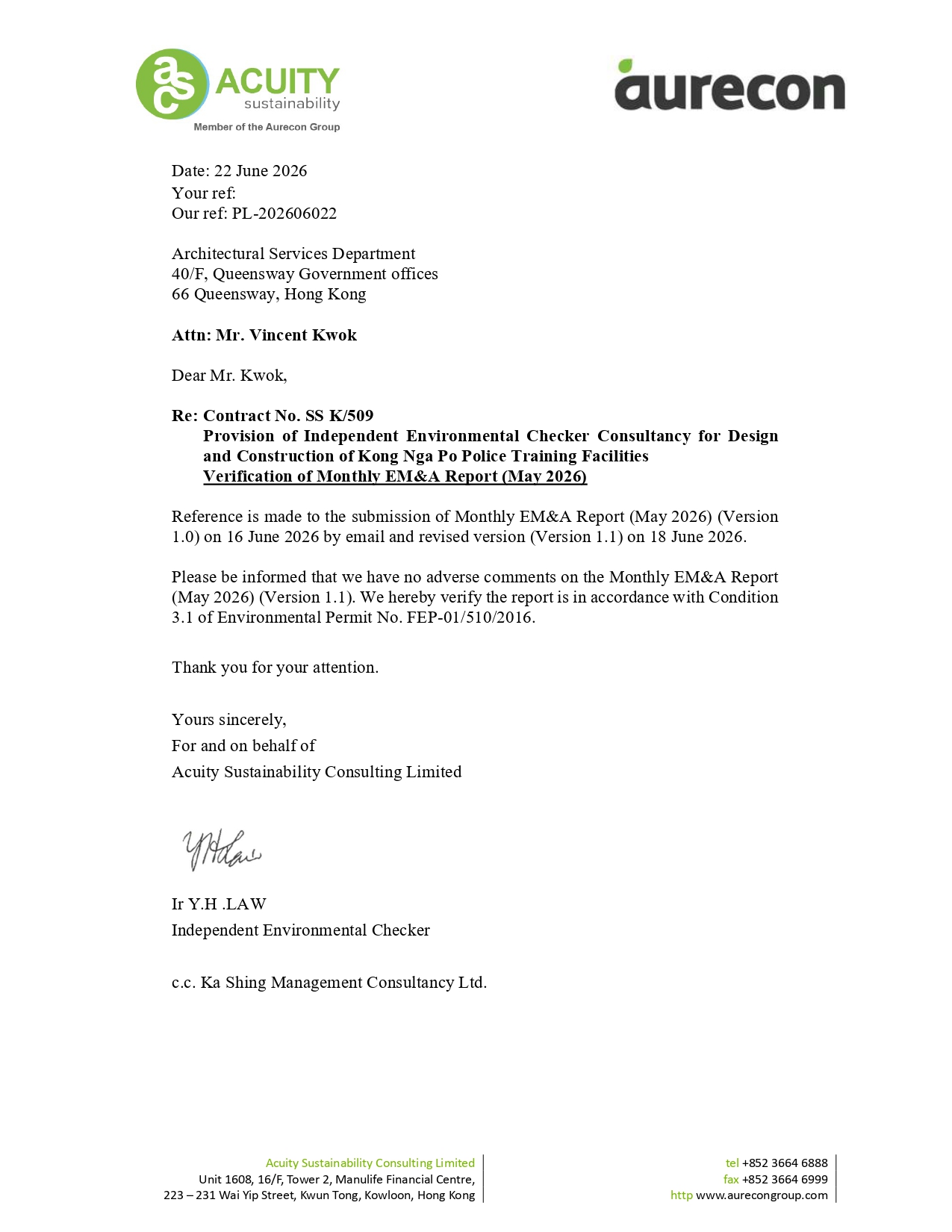
|
|
|
Page No. |
|
|
EXECUTIVE
SUMMARY |
|
|
|
Introduction |
5 |
|
|
Environmental Monitoring and Audit Progress |
5 |
|
|
Breaches of Action and Limit Levels |
5 |
|
|
Construction Noise |
5 |
|
|
Air Quality |
5 |
|
|
Ecological Monitoring |
6 |
|
|
Environmental Non-Compliance |
6 |
|
|
Environmental Complaint |
6 |
|
|
Notification of Summons and Successful
Prosecutions |
6 |
|
|
Reporting Changes |
6 |
|
|
Future Key Issues |
6 |
|
|
|
|
|
INTRODUCTION |
|
|
|
|
Purpose of the report |
7 |
|
|
Structure of the report |
7 |
|
|
|
|
|
2 |
PROJECT INFORMATION |
|
|
|
Background |
8 |
|
|
Project Organization |
8 |
|
|
Summary of Construction Works Undertaken
During Reporting Month |
8-9 |
|
|
Construction Programme |
9 |
|
|
Status of Environmental Licences,
Notifications and Permits |
9 |
|
|
Summary of EM&A Requirement |
9 |
|
|
Status of Compliance with Environmental
Permits Conditions |
9-10 |
|
|
|
|
|
3 |
NOISE MONITORING |
|
|
|
Monitoring Requirements |
11 |
|
|
Monitoring Location |
11 |
|
|
Monitoring Equipment |
11 |
|
|
Monitoring Parameters, Frequency and
Duration |
11-12 |
|
|
Monitoring Methodology and QA/QC Procedures |
12 |
|
|
Maintenance and Calibration |
12-13 |
|
|
Results and Observations |
13 |
|
|
Event and Action Plan |
13 |
|
|
|
|
|
4 |
AIR QUALITY MONITORING |
|
|
|
Monitoring Requirements |
14 |
|
|
Monitoring Location |
14 |
|
|
Monitoring Equipment |
14 |
|
|
Monitoring Parameters, Frequency and
Duration |
15 |
|
|
Monitoring Methodology and QA/QC Procedure |
15 |
|
|
Results and Observations |
15-16 |
|
|
Event and Action Plan |
16 |
|
|
|
|
|
5 |
LANDSCAPE AND VISUAL MONITORING |
|
|
|
Monitoring Requirements |
17 |
|
|
|
|
|
6 |
ECOLOGICAL MONITORING |
|
|
|
Monitoring of Flora Species of Conservation
Interest |
18 |
|
|
Post-Transplantation Monitoring and
Maintenance Programme |
18 |
|
|
Results and Observations |
18-19 |
|
|
Precautionary Measure for Butterfly Species
of Conservation Interest |
19 |
|
|
Precautionary Measures to Minimize Indirect
Disturbance on Ecology |
19 |
|
|
|
|
|
7 |
ENVIRONMENTAL SITE INSPECTION |
|
|
|
Site Audits |
20-21 |
|
|
Implementation Status of Environmental
Mitigation Measures |
21 |
|
|
Solid and Liquid Waste Management Status |
21 |
|
|
|
|
|
8 |
ENVIRONMENTAL NON-CONFORMANCE |
|
|
|
Summary of Exceedances |
22 |
|
|
Summary of Environmental Non-Compliance |
22 |
|
|
Summary of Environmental Complaint |
22 |
|
|
Summary of Environmental Summon and
Successful Prosecution |
22 |
|
|
|
|
|
9 |
FUTURE KEY ISSUES |
|
|
|
Key Issues in the Coming Three Months |
23-24 |
|
|
Monitoring Schedule for the Next Month |
24 |
|
|
|
|
|
10 |
CONCLUSIONS AND RECOMMENDATIONS |
|
|
|
Conclusions |
25 |
|
|
Recommendations |
25-26 |
LIST OF TABLES
Table I Summary
Table for EM&A Activities in the Reporting Month
Table II Summary
Table for Events Recorded in the Reporting Month
Table 2.1 Key
Contacts of the Project
Table 2.2 Status
of Environmental Licences, Notifications and Permits (Contract No. SSK509)
Table 2.3 Summary
Table for Status of Compliance / Required Submission
Table 3.1 Location
for Noise Monitoring Stations
Table 3.2 Noise
Monitoring Equipment
Table 3.3 Noise
Monitoring Parameters, Duration and Frequency
Table 3.4 Summary
Table of Noise Monitoring Results during the Reporting Month
Table 3.5 Observation
at Noise Monitoring Stations
Table 4.1 Location
for Air Quality Monitoring Locations
Table 4.2 Air
Quality Monitoring Equipment
Table 4.3 Impact
Dust Monitoring Parameters, Frequency and Duration
Table 4.4 Summary
Table of 1-hour TSP Monitoring Results during the Reporting Month
Table 4.5 Observation
at Dust Monitoring Stations
Table 5.1 Observations
and Recommendations of Site Audit
LIST OF FIGURES
Figure 1 Site
Layout Plan
Figure 2 Location
of Air Quality Monitoring Stations
Figure 3 Location
of Noise Monitoring Stations
LIST OF APPENDICES
Appendix A Construction
Programme and Proactive Environmental Protection Proforma
Appendix B Action and Limit Levels
Appendix C Copies of
Calibration Certificates
Appendix D Environmental
Monitoring Schedules
Appendix E Air Quality Monitoring
Results and Graphical Presentation
Appendix F Noise
Monitoring Results and Graphical Presentation
Appendix G Weather Condition
Appendix H Ecological
Monitoring Records
Appendix I Event
Action Plans
Appendix J Summary of
Exceedance
Appendix K Environmental
Mitigation Implementation Schedule (EMIS)
Appendix L Waste Generation
in the Reporting Month
Appendix M Complaint Log
Appendix N Summary of
Successful Prosecution
Appendix O The
potential seriousness of the forthcoming environmental impacts and the use of
machineries
Appendix P A List of
Machineries Used in Construction Site
Appendix Q Wastewater
Discharge Layout Plan
EXECUTIVE SUMMARY
Introduction
E1.
This document represents the 38th monthly report detailing the Environmental
Monitoring and Audit
(EM&A) activities for the Kong Nga Po Police Facilities Project, which
operates under Environmental Permit No. FEP-01/510/2016. This report was
prepared by Ka Shing Management Consultant Ltd. (Ka Shing) under “Service
Contract Quotation No. PMB202/8480/2022/A01/A Provision of Environmental Team
consultancy for Design and Construction of Kong Nga Po Police Training
Facilities” (hereinafter called the “Service Contract”). The report
encapsulates the EM&A activities and findings carried out between the 1st
and 31st of May 2026.
E2.
On the 23rd of December 2022, a section of the construction site was
transferred to the Architectural Services Department (ArchSD), which assumed
responsibility for the building's construction. Furthermore, ArchSD has taken
on the role of maintenance agent for the Hong Kong Police Force (HKPF)
throughout the operational phase.
E3.
In the month covered by this report, the Project of Police Facilities at Kong
Nga Po, which operates under Environmental Permit No. FEP-01/510/2016, engaged
in the following contractual work: Contract No. SSK509, which encompasses the
design and construction of the Kong Nga Po Police Training Facilities.
Environmental Monitoring and Audit Progress
E4. A
summary of the EM&A activities in this reporting month is listed in Table
I below:
Table I
Summary Table for EM&A Activities in the Reporting Month
|
EM&A Activities |
Date |
|
Noise Monitoring |
6, 12, 18, 29 May 2026 |
|
Air Quality Monitoring |
6, 12, 18, 23, 29 May 2026 |
|
Environmental Site Inspection |
6, 12, 18, 29 May 2026 |
|
Ecological Monitoring |
29, 30 May 2026 |
|
Landscape & Visual Inspection |
6, 12, 18, 29 May 2026 |
Breaches of Action and Limit Levels
E5. Summary
of the environmental exceedances of the reporting month is tabulated in Table
II.
Construction Noise
E6.
During the reporting month, the
planned noise monitoring for construction took place as scheduled, with no
recorded incidents of the Action/Limit Levels being exceeded.
Air Quality
E7. Throughout the reporting period,
all planned air quality monitoring associated with construction was executed,
and there were no recorded instances where the Action/Limit Levels were
surpassed.
Table II Summary Table for Events
Recorded in the Reporting Month
|
Environmental Monitoring |
Parameter |
No. of Non-Project related Exceedances |
No. of Exceedance related to the Construction Works
of the Contract |
Action Taken |
||
|
Action Level |
Limit Level |
Action Level |
Limit Level |
|||
|
Noise |
Leq(30min) |
0 |
0 |
0 |
0 |
N/A |
|
Air Quality |
1-hr TSP |
0 |
0 |
0 |
0 |
N/A |
Ecological Monitoring
E8. The ecological monitoring slated
for the reporting month was conducted according to schedule. Details of the
findings from this ecological monitoring for the respective period are
available in Appendix H.
Environmental Non-Compliance
E9. During
the reporting month, no environmental compliance violations were documented.
Environmental Complaint
E10. No environmental
complaints were recorded during the reporting period. In the event of any
complaints, they would be documented in the Complaint Log found in Appendix
M.
Notification of Summons and Successful
Prosecutions
E11. Throughout the month covered in this report,
there were no instances of receiving notifications regarding summons or
confirmations of successful prosecutions.
Reporting Changes
E12. On the 23rd of December 2022, a section of the
construction site was handed over to the Architectural Services Department
(ArchSD). ArchSD has taken on the task of overseeing the construction
activities for the building. This Monthly Environmental Monitoring and Audit
(EM&A) Report offers a summary of the site operations and the status of the
environmental safeguards being implemented under the contract with ArchSD.
Future Key Issues
E13. The
major site activities for the coming three months include:
1.
Open cut excavation
2.
Removal of soil
3.
Construction of
substructure and superstructure
4.
Backfilling
5.
U.U. Lead in and Pipe
Duct Connection
6.
E&M installation
E14. The aforementioned construction
activities could potentially lead to environmental impacts, with the primary
concerns centered around construction dust, noise, water quality, and waste
management. For detailed information, please refer to Appendix A regarding the
anticipated major impacts from the construction works and corresponding
recommended mitigation measures.
1
INTRODUCTION
1.1
The ArchSD has
commissioned Ka Shing Management Consultant Ltd. (Ka Shing) as the
Environmental Team (ET) to conduct the Environmental Monitoring and Audit
(EM&A) activities for the Kong Nga Po Police Facilities Project, as
dictated by Environmental Permit No. FEP-01/510/2016.
1.2
The main construction
activities for the Project began on the 3rd of July, 2020, and the primary
location at Kong Nga Po was handed over to the ArchSD on the 23rd of December,
2022. The ArchSD has assumed control over the building construction tasks and will
serve as the maintenance representative for the Hong Kong Police Force (HKPF)
once the project is operational.
Purpose of the report
1.3 This document constitutes the 38th
EM&A Report, offering a consolidated overview of the monitoring outcomes
for impacts and the audit results from the EM&A program over the reporting
interval spanning from the 1st and 30st of May 2026.
Structure of the report
1.4
The structure of the report is as follows:
Section 1: Introduction
Section
2: Project Information
Section 3: Noise Monitoring
Section
4: Air Quality Monitoring
Section
5: Landscape and Visual Monitoring
Section
6: Ecological Monitoring
Section
7: Environmental Site Inspection.
Section 8: Environmental Non-conformance
Section 9: Future Key Issues
Section 10:
Conclusions and Recommendations
2 PROJECT
INFORMATION
Background
2.1 The Project mainly includes
construction and operation of various police facilities. The police
facilities include:
(i) a helipad;
(ii) two
firing ranges; and
(iii) other
facilities, associated infrastructure & utilities, etc.
2.2 The Project falls under the
category of a Designated Project as defined by the Environmental Impact
Assessment Ordinance (EIAO). In October 2016, an Environmental Impact
Assessment (EIA) Report (Report No.: AEIAR-201/2016) was approved for the
Project in accordance with the EIA Study Brief (No. ESB-276/2014) and the
Technical Memorandum on Environmental Impact Assessment Process (EIAO-TM). The
corresponding Environmental Permit (EP no.: FEP-01/510/2016) was issued by the
Director of Environmental Protection (DEP).
2.3 As per the approved Environmental
Monitoring and Audit (EM&A) Manual, a comprehensive air quality and noise
monitoring program is recommended during the construction phases of the Project
to assess and monitor potential dust and noise nuisances. Prior to the
commencement of the Project's construction works, baseline air quality and
noise monitoring were conducted by the previous Environmental Team (Wellab
Limited) from 14th March, 2020, to 2nd April, 2020, to establish the
pre-existing conditions at designated sensitive receivers.
2.4 Figure
1 displays the site layout plan for the Project.
Project Organization
2.5 Various stakeholders with varying
degrees of participation are part of the Project's organizational structure
under Environmental Permit number: FEP-01/510/2016, which includes:
Project Proponent –
Architectural Services Department (ArchSD)
Contractor– China
State JV
Environmental Team
(ET) – Ka Shing Management Consultant Ltd.
Independent
Environmental Checker (IEC) – Acuity Sustainability Consulting Limited
2.6 Table 2.1 summarizes the
contact information for key personnel associated with Quotation No.
PMB202/8480/2022/A01/A and additional contacts linked with the ArchSD Contract
No. SSK509.
Table 2.1 Key
Contacts of the Project
|
Party |
Role |
Contact Person |
Phone No. |
Fax No. |
|
Architectural Services Department |
Project Proponent |
Mr. Vincent Kwok |
2867 3939 |
3542 5223 |
|
Contractor (China State JV) |
Site Agent |
Mr. Kelvin Chan |
6272 8828 |
2866 6325 |
|
Environmental Officer |
Ms. Marian Kong |
6174 9735 |
||
|
Mr. LuLu Mar |
5998 8852 |
|||
|
Ka Shing Management Consultant Ltd. |
ETL |
Mr. W.H. Lee |
2618 2166 |
2120 7752 |
|
Acuity Sustainability Consulting Limited |
IEC |
Ir. Y.H. Law |
2698 6833 |
2698 9383 |
Summary of Construction Works Undertaken
During Reporting Month
2.7 Significant
site activities conducted on-site during the reporting month comprised:
1.
Open cut excavation
2.
Removal of soil
3.
Construction of
substructure and superstructure
4.
Backfilling
5.
U.U. Lead in and Pipe
Duct Connection
6.
E&M installation
7.
Installation of precast
baffle steel frame at 25m baffle range
Construction Programme
2.8 Appendix A contains a
version of the Contractors' construction schedules. The primary site activities
planned by the Contractor for the upcoming three months have been examined. In Appendix
O, the expected environmental impacts' potential severity and the
deployment of equipment have been evaluated. This appendix additionally
provides the Contractor with recommendations and insights on alternative
approaches aimed at raising environmental consciousness, refining practices on
the construction site, and fostering environmental improvements.
2.9 Table 2.2 presents a
consolidated overview of the pertinent environmental protection permits,
licenses, and/or notifications associated with this Project.
Table 2.2 Status
of Environmental Licences, Notifications and Permits
|
Permit / Licence No. |
Valid
Period |
Status |
|
|
From |
To |
||
|
Further Environmental Permit (FEP) |
|||
|
FEP-01/510/2016 |
N/A |
N/A |
Valid |
|
Construction Noise Permit (CNP) |
|||
|
GW-RN0315-26 |
10-03-2026 |
09-08-2026 |
Valid |
|
Notification pursuant to Air Pollution Control (Construction
Dust) Regulation |
|||
|
EPD Ref no.: 487864 |
N/A |
N/A |
N/A |
|
Billing Account for Construction Waste Disposal |
|||
|
Account No. 7046289 |
18-01-2023 |
N/A |
Valid |
|
Registration of Chemical Waste Producer |
|||
|
WPN5213-641-C4770-01 |
18-01-2023 |
N/A |
Valid |
|
Effluent Discharge Licence under Water Pollution
Control Ordinance |
|||
|
WT00043663-2023 |
21-04-2023 |
30-04-2028 |
Valid |
Summary
of EM&A Requirement
2.10 The Environmental Monitoring and Audit
(EM&A) program includes the monitoring of construction noise, air quality,
ecological conditions, and regular environmental site audits. The specific
requirements for the EM&A program are outlined in the following sections:
●
Environmental
requirements in contract documents;
●
Event / Action Plans;
●
Environmental mitigation
measures, as recommended in the Project EIA study final report;
●
All monitoring
parameters; and
●
Action and Limit levels
for all environmental parameters.
Status of Compliance with Environmental
Permits Conditions
2.11 Table 2.3 provides a summary of
the adherence to Environmental Permit (EP) No. FEP-01/510/2016 and the
necessary submissions connected to this Project as stipulated by the EP.
Table 2.3 Summary
Table for Status of Compliance / Required Submission under FEP No.
FEP-01/510/2016
|
FEP Conditions |
Submission |
Submission Date |
Approval Status |
|
1.12 |
Commencement date
of construction of the
Project |
30/3/2023 |
* |
|
2.7 |
Proposal on the
Reporting Mechanism and Curriculum Vitae of the IEC |
20/3/2023 |
* |
|
2.10 |
The date of setting
up the Community Liaison Hotline and the contact details |
27/2/2023 |
* |
|
2.11 |
Management
Organization of Main
Construction Companies, at least
an organization chart, names of responsible
persons and their contact
details |
10/3/2023 |
* |
|
2.12 |
Construction Works
Schedule and Location Plans |
10/3/2023 |
* |
|
2.13 |
Layout plan for
permeable pavings. |
Submitted to EPD on 29/3/2023. Supplementary
information submitted to EPD on 23/3/2024. R1 was submitted to ET & IEC on 11/9/2025. R-to-C of ET was submitted thru email on 27/11/2025. Revision was submitted to ET on 23/12/2025. Submitted to EPD on 6/1/2026. |
For approval |
|
2.14 |
Landscape and
visual mitigation plan |
Submitted to EPD on 24/3/2025. R2 was submitted to ArchSD for review on 19/9/2025. R2 was submitted to ET & IEC on 25/11/2025. R2 was submitted to ET & IEC on 13/1/2026. R2 was submitted to EPD on 11/3/2026 thru email.
Hardcopy was submitted on 16/3/2026. |
For approval |
|
2.16 |
Plan for perimeter
walls/ boundary wall sat project site and sidewalls of firing range |
6/12/2024 Supplementary information submitted to EPD by email
on 2/5/2025. |
For approval |
|
2.19 |
Submission of
Helicopter Flight Plan |
1 month before commencement of operation of Helipad |
Notification |
|
3.3 |
Baseline Air
Quality and Noise Monitoring Report |
30/3/2023 |
Deposit |
|
4.2 |
Internet address of
a dedicated web site |
13/4/2023 |
* |
Remarks:
* Approval not required in
FEP-01/510/2016
3 NOISE
MONITORING
Monitoring Requirements
3.1 Following
the EM&A Manual, monitoring of construction noise was performed by
measuring the A-weighted equivalent continuous sound pressure level (Leq) to
track noise generated by construction operations. Each monitoring station is
scheduled for weekly noise assessments, with one set of readings to be taken
from 0700 to 1900 hours on typical weekdays. The predefined Action/Limit Levels
for the environmental monitoring activities are presented in Appendix B.
Monitoring Location
3.2 As
per Section 3.2.3 of the EM&A Manual, impact noise monitoring took place at
fourteen specified noise monitoring stations. Following the guidelines of the
Project's Environmental Impact Assessment (EIA) report, noise monitoring
stations situated within a 300-meter radius of the Project's boundary were
taken into account. Consequently, six noise monitoring stations identified as
relevant monitoring locations are depicted in Figure 3. The specific locations
of these noise monitoring stations are detailed in Table 3.1.
Table 3.1
Location of Noise Monitoring Stations
|
Monitoring Station |
Location of Measurement |
|
NM9 |
Village House, Kong Nga Po |
|
NM10 |
Village House, Kong Nga Po |
|
NM11 |
Village House, Kong Nga Po |
|
NM12 |
Village House, Kong Nga Po |
|
NM13 |
Village House, Kong Nga Po |
|
NM14 |
Village House, near Man Kam To Road |
Monitoring
Equipment
3.3 Impact
noise monitoring was carried out using Integrating Sound Level Meters. These
meters, classified as Type 1, are capable of providing continuous readings of
noise levels, including the equivalent continuous sound pressure level (Leq)
and percentile sound pressure level (Lx), and they conform to the
specifications of International Electrotechnical Commission Publications
651:1979 (Type 1) and 804:1985 (Type 1). The noise monitoring equipment
utilized is summarized in Table 3.2. The calibration certificates for
these devices can be found in Appendix C.
Table 3.2 Noise
Monitoring Equipment
|
Equipment |
Model |
Quantity |
|
Sound Level Meter |
BSWA 308 |
3 |
|
Sound Level Meter |
Rion NL53 |
1 |
|
Sound Calibrator |
SOUNDTEK
ST-120 |
1 |
Monitoring
Parameters, Frequency and Duration
3.4
Table 3.3 encapsulates the variables monitored, the frequency of
monitoring, and the total time span of the noise monitoring activities. The
schedule for noise monitoring can be located in Appendix D.
Table 3.3 Noise
Monitoring Parameters, Duration and Frequency
|
Monitoring Stations |
Parameter |
Duration |
Frequency |
Measurement |
|
NM9 |
L10(30 min.) dB(A)[2] |
0700-1900 hrs on normal
weekdays |
Once per week |
Free field[1] |
|
NM10 |
Free field[1] |
|||
|
NM11 |
Façade |
|||
|
NM12 |
Façade |
|||
|
NM13 |
Free field[1] |
|||
|
NM14 |
Free field[1] |
Remarks:
[1]:
Correction of +3dB (A) for Free-field Measurement.
[2]:
A-weighted equivalent continuous sound pressure level (Leq). It is the constant
noise level which, under a given situation and time period, contains the same
acoustic energy as the actual time-varying noise level.
L10 is
the level exceeded for 10% of the time. For 10% of the time, the sound or noise
has a sound pressure level above L10.
L90 is
the level exceeded for 90% of the time. For 90% of the time, the noise level is
above this level.
Monitoring
Methodology and QA/QC Procedures
3.5 The
procedures for noise monitoring were conducted in this manner:
- The
sound level meter was mounted on a tripod, positioned 1 meter away from the
outside of the noise-sensitive facade and at a height of 1.2 meters above
ground level;
- To
achieve free field measurement conditions, the meter was placed at a distance
from any reflective surfaces, and the measured noise levels were then corrected
by adding +3 dB(A);
-
The battery's condition was examined to guarantee the proper operation of the
meter;
- The
settings for parameters like frequency weighting, time weighting, and
measurement duration were established as detailed below:
-frequency weighting: A
-time weighting: Fast
-time measurement: Leq(30 min.) dB(A)
-
Noise levels were measured as six consecutive Leq, 5-minute readings during the
hours when restrictions did not apply (specifically, from 0700 to 1900 hrs on normal weekdays).
-
Calibration of the meter was performed before and after each noise measurement
session using a Calibrator set to 94.0 dB at 1000 Hz. Should there be a
discrepancy greater than 1.0 dB in calibration levels pre- and
post-measurement, the data would be deemed invalid. A repeat measurement would
then be necessary following recalibration or repair of the equipment.
-
Throughout the monitoring period, parameters such as Leq, L90, and L10 were
documented. Observations regarding site conditions and noise origins were also
noted on a standard recording form.
-
Noise measurements were temporarily halted during instances of significant
intrusive noise (for example, barking dogs or helicopter sounds), where
feasible. An observation record for the measurement period was to be provided.
-
Noise monitoring was suspended in conditions of fog, rain, or when wind speeds
were consistently above 5 m/s, or during gusts surpassing 10 m/s. Wind speeds
were verified using a portable anemometer capable of measuring speed in meters
per second (m/s).
Maintenance and
Calibration
3.6 Every
three months, the microphone head of the sound level meter and the calibrator
was gently wiped clean using a soft fabric.
3.7 Annually the sound level
meter and calibrator underwent inspection and calibration.
3.8 Before
and after conducting each noise measurement, the precision of the sound level meter must be
verified with an acoustic calibrator that produces a set sound pressure level
at a specific frequency. Only when the pre- and post-measurement calibration
levels are within a 1.0 dB range of each other will the measurements be
considered valid.
Results and
Observations
3.9 Table
3.4 provides a summary of the noise monitoring outcomes. For an in-depth
account and visual depiction of the noise monitoring, refer to Appendix F.
A summary of the meteorological data for the reporting period is compiled in Appendix
G.
Table 3.4
Summary Table of Noise Monitoring Results during the Reporting Month
|
Monitoring Station |
Average |
Range |
Baseline Level |
Limit Level |
|
Leq (30 min) dB(A) |
Leq (30 min) dB(A) |
dB(A) |
dB(A) |
|
|
NM9[1] |
54.7 |
41.4-65.1 |
55.9 |
75 |
|
NM10[1] |
58.7 |
47.1-63.2 |
52.8 |
|
|
NM11 |
63.3 |
49.2-72.9 |
46.4 |
|
|
NM12 |
58.7 |
48.6-63.0 |
54.7 |
|
|
NM13[1] |
58.2 |
48.1-69.2 |
61.3 |
|
|
NM14[1] |
61.0 |
48.6-71.5 |
59.6 |
Remarks: [1]: Correction of +3dB (A) for Free-field
Measurement.
3.10 Noise
monitoring related to construction activities took place according to the
planned schedule for the month reported. There were no instances where the
Action/Limit Levels were surpassed. A summary of exceedance records for the
reporting month can be found in Appendix J.
3.11 Based
on observations made in the field, the primary sources of noise detected at the
allocated noise monitoring stations during the reporting month are as outlined
below:
Table 3.5
Observation at Noise Monitoring Stations
|
Monitoring Station |
Major Noise Source |
|
NM9 |
Loading & unloading, Road traffic, Excavation
works |
|
NM10 |
Loading & unloading, Road traffic, Excavation
works |
|
NM11 |
Road traffic |
|
NM12 |
Loading & unloading, Road traffic |
|
NM13 |
Loading & unloading, Road traffic |
|
NM14 |
Dog barking, Road traffic |
Event and Action
Plan
3.12 If
any non-compliance with the criteria related to the project arises, measures
will be taken following the procedures outlined in the Event Action Plan
provided in Appendix I.
4 AIR
QUALITY MONITORING
Monitoring Requirements
4.1 As per the EM&A Manual, 1-hour
Total Suspended Particulates (TSP) monitoring was carried out to keep track of
the air quality associated with the Works Contracts. The predetermined
Action/Limit Levels for the air quality monitoring activities are detailed in Appendix
B.
4.2 Monitoring for 1-hour Total Suspended Particulates (TSP) impacts was performed at a minimum of three times within each six-day period at a designated air quality monitoring station.
Monitoring Location
4.3 In line with Section 2.2.5 of the
EM&A Manual, impact air quality monitoring took place at two specified
monitoring stations for the Project, as depicted in Figure 2. The positions of
the air quality monitoring stations are detailed in Table 4.1.
Table 4.1 Location for Air
Quality Monitoring Stations
|
Monitoring Station |
Location of Measurement |
|
AM1 |
Village House, Kong Nga Po |
|
AM2 |
Village House, Kong Nga Po |
Monitoring Equipment
4.4 Due to the denial by local
villagers to set up a High-Volume Sampler (HVS) for 1-hour Total Suspended Particulates
(TSP) monitoring at the chosen locations and the inability to secure an
electricity supply for the HVS, direct-reading dust meters were utilized
instead to conduct the 1-hour TSP monitoring. Direct-reading dust meters are
widely accepted instruments for measuring 1-hour TSP levels and have been used
in the same infrastructure project. The issue to use direct-reading dust meters
was presented to the Independent Environmental Checker (IEC). The application
of the direct-reading dust meter allows for immediate and straightforward
results, facilitating timely EM&A reporting and the execution of the event
and action plan. To ensure the validity and accuracy of the readings obtained
by the direct-reading method, the HVS performed 1-hour sampling on a bi-monthly
schedule.
4.5 Table 4.2 provides a summary
of the apparatus employed in the impact air quality monitoring program. The
calibration was conducted by Aquality Testconsult Limited. Copies of the calibration certificates
for the equipment can be found in Appendix C.
Table 4.2 Air
Quality Monitoring Equipment
|
Equipment |
Model and Serial No. |
Quantity |
The valid period is until |
|
Dust Monitor |
AEROCET-831/ F 12045 |
1 |
12 May 2027 |
|
Dust Monitor |
AEROCET-831/ F12258 |
1 |
1 Jun 2026 |
4.6 Weather
data was sourced from the "Hong Kong Observatory - General Weather
Conditions during the Monitoring Period (May 2026)" detailed in Appendix
G, which was used as a substitute approach to acquire representative wind
data.
4.7 During the monitoring days, the field staff also
documented the prevailing weather conditions, such as whether it was sunny,
cloudy, fine or rainy.
Monitoring
Parameters, Frequency and Duration
4.8 Table
4.3 encapsulates the monitoring variables and the regularity of impact dust
assessments conducted throughout the Works Contracts operations. The schedule
for air quality observation for the month in question is presented in Appendix
D.
Table 4.3 Impact Dust Monitoring
Parameters, Frequency and Duration
|
Parameters |
Frequency |
|
1-hr TSP |
Three times/ 6 days |
Monitoring
Methodology and QA/QC Procedure
1-hour
TSP Air Quality Monitoring
Instrumentation
4.9
The air quality monitoring utilized a direct reading dust meter, as indicated
in Table 4.2.
4.10 The
procedures for operating the dust meter adhere to the guidelines set forth in
the Manufacturer’s Instruction Manual, as described below:
-The 1-hour dust meter
is placed at least 1.3 meters above ground.
-Press and hold the
Power key momentarily to power on the unit and make sure that the battery level
was not flash or in low level.
-Allow the instrument
to stand for about 3 second to display the Sample Screen minutes.
-Press the START / STOP
key to run the internal vacuum pump for 1 minute and ready to use.
-Use the select dial to
select the PM range and press the START / STOP key to start a measurement.
-Finally, push the
START/STOP key to stop the measuring after 3-hour sampling.
-Information such as
sampling date, time, value and site condition were recorded during the
monitoring period.
-All data were recorded
in the data logger for further data processing.
Maintenance/Calibration
4.11 The dust meter required
the following maintenance and calibration:
- The
dust meter must be checked and calibrated against a High Volume Sampler (HVS)
to validate the precision and accuracy of the readings obtained through the
direct reading method.
- The
correlation between the dust meter and HVS in measuring TSP was established by
directly comparing the mass of dust particles collected on a filter paper by
the HVS against the dust meter's reading. For accurate calibration, both the
dust meter and the HVS should be turned on and off at the same location and at
the same time.
- The
correlation coefficient was verified to confirm the relationship between the
readings from the dust meter and the HVS. This correlation factor was
ascertained by comparing the outcomes from both the HVS and the dust meter.
-
Prior to the initiation of dust monitoring, a check must be conducted to verify
that all equipment is operational and has the necessary power supply. A zero
count test was performed before and after each monitoring session to ensure
accuracy.
Results and
Observations
4.12 The
outcomes of the 1-hour TSP monitoring are condensed in Table 4.4. For a
comprehensive view, detailed results and graphical representations of the
1-hour TSP monitoring data can be found in Appendix E.
Table 4.4
Summary Table of 1-hour TSP Monitoring Results during the Reporting
Month
|
Monitoring Station |
Concentration |
Action Level, µg/m3 |
Limit Level, µg/m3 |
|
|
(µg/m3) |
||||
|
Average |
Range |
|||
|
AM1 |
117 |
51-272 |
308 |
500 |
|
AM2 |
126 |
35-224 |
311 |
|
4.13 The
1-hour TSP monitoring took place according to the planned timetable for the
reporting month, and there were no instances of exceeding the established
Action/Limit Levels.
4.14 Based
on field observations, the primary sources of dust at the specified air quality
monitoring stations during the reporting month are listed in Table 4.5.
Table 4.5 Observation at Dust
Monitoring Stations
|
Monitoring Station |
Major Dust Source |
|
AM1 |
Equipment operation
and movement / road traffic, exposed site area, site vehicle |
|
AM2 |
Road traffic,
exposed site area, site vehicle / equipment operation and movement, vehicle /
equipment operation and movement at warehouse nearby |
Event and Action
Plan
4.15 In
the event of a project-related violation of the criteria, measures will be
taken as specified by the Event Action Plan detailed in Appendix I.
5 LANDSCAPE
AND VISUAL MONITORING
Monitoring
Requirements
5.1 The EIA Report recommends implementing strategies
to mitigate impacts on landscape and visual resources throughout
both the construction and operational phases of the Project.
5.2 The
execution and upkeep of compensatory planting for landscaping are critical
components of this process and must be monitored to confirm their complete
fulfillment. It is essential to promptly address any potential clashes between
the proposed landscaping efforts and other Project tasks or operational needs
to ensure that the mitigation measures' objectives are not compromised.
Furthermore, the enforcement of the mitigation measures advised by the EIA will
be tracked continuously through the site audit program for the construction
phase.
5.3 The
Environmental Team (ET) carried out a fortnightly review of the execution of
measures aimed at mitigating landscape and visual impacts as part of the weekly
site audits. The findings and observations from these audit sessions are
encapsulated in Table 5.1, while the status of implementation can be
found detailed in Appendix K.
6 ECOLOGICAL
MONITORING
Monitoring of Flora
Species of Conservation Interest
6.1 In
line with Section 8.3.2 of the EM&A Manual, a temporary protective barrier
must be installed around the plant species of conservation significance
identified in the detailed vegetation survey throughout the construction phase.
This barrier should be well-maintained and regularly checked to ensure its
effectiveness. Monthly checks of each plant species of conservation interest,
as pinpointed in the detailed vegetation survey, are required during the
construction phase to ensure that these species remain unaffected by the
project's construction activities.
6.2 The
monitoring aims to oversee the prompt execution of suitable environmental
management practices and the application of mitigation measures concerning the
preserved and relocated specimens of flora species of conservation interest.
The correct setup and upkeep of the temporary protective fence surrounding
these specimens were examined to assess its efficacy. The protective measures
outlined in the approved transplantation proposal's implementation schedule
were supervised.
6.3 As
per the sanctioned detailed vegetation survey report and transplantation
proposal, it was determined that 71 Brainea
insignis specimens, 41 Spiranthes
sinensis specimens, and 3 Aquilaria sinensis specimens should be
relocated to the designated receiving site. Additionally, it was decided to
preserve in situ 51 Keteleeria fortunei specimens, along with 26 small
seedlings of Keteleeria fortunei and 7 small seedlings of Aquilaria
sinensis, in the vicinity of Kong Nga Po Road near the Police Dog Unit and
the Force Search Unit Training School.
Post-Transplantation
Monitoring and Maintenance Programme
6.4 In
line with the accepted transplantation proposal, the Contractor is mandated to
carry out post-transplantation monitoring weekly for the first three months,
and then monthly for the remainder of the 12-month establishment phase as well
as the subsequent post-establishment phase, continuing until the construction
phase of the Project concludes. This routine monitoring is critical for
promptly identifying the growth condition of the transplanted species, any
signs of construction work within or in the vicinity of the receptor site, and
any changes in the environmental conditions of the receptor site.
6.5 For
the initial year of acclimatization, it was advised to carry out maintenance
activities to promote the robust growth of the transplanted species.
Considering the state of the transplanted organisms following the 12-month
establishment period, it was advised that maintenance activities continue
through the Post-establishment Period until the completion of the Construction
Phase. It was recommended to water the transplants daily for the first three
months following the move, as well as throughout periods of drought, to
maintain soil moisture. Additional maintenance tasks, such as mulching and
weeding, should be performed as necessary.
Results and
Observations
6.6 During
the reporting month, the Contractor carried out monthly evaluations of the
flora species of conservation interest on the 30 May 2026. The enforcement of
the protective measures detailed in the approved transplantation proposal was
reviewed, along with the maintenance of the temporary protective fencing. Appendix
H contains the photographic documentation and checklists from the monthly
assessments. The health of the transplanted and retained species was generally
observed to be average to poor. The Contractor was urged to keep a vigilant eye
on the transplanted species and to implement the protective measures as
specified in the approved transplantation proposal to safeguard these species.
Furthermore, the Contractor was given the following directives:
1)
To provide new identification tags for any Brainea
insignis that were missing them;
2)
To substitute any plant labels at the receptor site that had become illegible
due to fading;
3)
To refer to the soil improvement guidelines published by the Greening,
Landscape and Tree Management Section (GLTMS) of the Development Bureau (2022)
for application in the monitoring and upkeep of the transplanted plant species;
4)
To set up shade nets;
5)
To ensure the soil remains moist by adhering to the necessary daily watering
schedule.
Transplanted Brainea insignis and Spiranthes
sinensis
6.7 From
May 21st to 28th, 2020, 71 Brainea insignis
specimens and 41 Spiranthes sinensis
specimens were relocated to the receptor site. The detailed account of the
transplantation process was compiled in a Transplantation Report and forwarded
to ET(Wellab), IEC(Acuity), and the Supervisor (AECOM) for their examination
and documentation. Monitoring after transplantation took place weekly for the
initial three months (from June to August 2020) and then monthly throughout the
subsequent 12-month establishment period, as well as the post-establishment
phase, culminating with the conclusion of the construction phase of the
Project. The Contractor was responsible for tracking the health of the
transplanted species and carried out maintenance measures such as watering,
mulching, and weeding during the first year to nurture the transplanted
species' healthy development. Monitoring of the transplanted Brainea insignis and Spiranthes
sinensis took place on the 30 May 2026.
, within the reporting period, with the findings
documented in Appendix H. Particular attention was given to the
transplanted Brainea insignis specimens
that were impacted by a bushfire on February 2nd, 2021, with their progress
detailed in the post-transplantation monitoring records. The health of the
preserved species was noted to be generally fair. The Contractor was advised to
maintain vigilant monitoring of these species and to enforce the stipulated
protective measures to ensure their continued preservation.
6.8 During
the monthly checks, it was observed that there were no construction operations
or storage of equipment taking place within the receptor site. The temporary
protective barrier had been correctly installed and was being well-maintained
to safeguard the transplanted species.
Precautionary
Measure for Butterfly Species of Conservation Interest
6.9
As stipulated by FEP
Condition 2.17, to reduce the impact on butterfly species of conservation
concern, efforts shall be made to improve the new grassland habitats within the
Project site. This enhancement shall be achieved by cultivating suitable plant species
that serve as the larval food source for butterflies of conservation interest,
like the Small Three-Ring, thereby supporting the well-being of these species.
6.10
The restoration of
grassland zones within the Project must be completed prior to the initiation of
the Project's operational phase. Information regarding the plant species to be
used as larval food plants for butterflies, along with the design and execution
details, will be subsequently provided under the building works contract of
ArchSD.
Precautionary
Measures to Minimize Indirect Disturbance on Ecology
6.11
As outlined in Section
9.7.3 of the EIA Report, implementing mitigation strategies for air, noise,
water, waste, and landscaping can serve as preventative actions to avert and
lessen any secondary effects of disturbance or pollution resulting from
construction activities on the surrounding ecology and habitats outside the
site. The Environmental Team (ET) conducted weekly site audits to oversee the
prompt adoption of appropriate environmental management practices and the
execution of mitigation measures at the Project site. The findings from these
audits are consolidated in Section 7.3.
7 ENVIRONMENTAL
SITE INSPECTION
Site Audits
7.1 The
Environmental Team (ET) conducted site audits weekly to oversee the prompt
adoption of appropriate environmental management practices and the execution of
mitigation measures at the Contract site.
7.2 The
Environmental Team (ET), along with representatives from the Client and the
Contractor, conducted site audits on 6, 12, 18, 29 May 2026 of the reported
month in 2026.
7.3 In
the site inspections conducted over the reporting period, there were no
particular environmental concerns noted. It should be recognized that these
observations pertain solely to the moments of inspection. The findings and
advice from these audits are compiled in Table 5.1. The absence of
identified environmental issues during the joint site inspections does not
exempt the Contractor from their obligation to adhere strictly to all legal
requirements, the Particular Specifications, and the Environmental Monitoring
and Audit (EM&A) Manual.
Table 5.1 Observations
of Weekly site Inspection and advice
|
Parameters |
Date |
Observations |
Advice |
|
Air Quality Impact Construction Phase |
6-5-2026 |
The construction activity is situated near a
forested area. The exposed soil may generate fugitive dust during windy conditions
or on dry days. This dust can settle on nearby leaves, potentially impairing
photosynthesis |
The exposed soil
along the slope is covered by sufficient impervious sheets |
|
Waste Management Implications Construction Phase |
12-5-2026 |
Bags of construction materials (cement) have been torn, spilling their contents onto the ground, rendering them unusable and ultimately leading to waste generation |
Plan the use of construction materials carefully to minimise amount of waste generated and avoid unnecessary generation of waste |
|
Water Quality Impact Construction Phase |
18-5-2026 |
Gray water may flow
into the gullies during rainfall |
To prevent the ingress of gray water, the gullies shall be fully covered |
|
Other |
29-5-2026 |
The sunshade nets have been reinstalled, except for one which was not reinstalled to protect the Ladies' Tresses (Spiranthes sinensis). |
The sunshade net is reinstalled to protect the Ladies' Tresses (Spiranthes sinensis). |
Implementation
Status of Environmental Mitigation Measures
7.4
In accordance with the
EIA Report and the Project's EM&A Manual, the outlined mitigation measures
are recommended to be implemented throughout the construction phase. An
overview of the Environmental Mitigation Implementation Schedule (EMIS) is
available in Appendix K.
Solid and Liquid Waste Management Status
7.5 Pursuant
to the EM&A Manual, waste management practices were reviewed in the weekly
site audits to assess compliance with the Project's Waste Management Plan (WMP)
and pertinent legal and contractual obligations. The auditing process
encompassed the examination of waste handling, storage, transport, and disposal
methods.
7.6 The
Contractor has appointed Environmental Officers on-site to manage environmental
aspects, implement pollution control strategies, maintain proper site conduct,
and educate workers on waste management. Efforts to reduce waste production
include actively using Construction and Demolition (C&D) materials.
Excavated materials have been sorted and screened on-site to salvage any
recyclables. Non-reactive C&D materials were utilized on-site for backfill
and to construct the haul road surface. Furthermore, inert materials from
excavation activities were repurposed as fill in other local projects. Excess
inert C&D materials were sent to the Government’s public fill reception
facilities (PFRFs) for use in other projects. To oversee the disposal of inert and
non-inert C&D materials and prevent illegal dumping, a system is in place
where all materials are weighed by a weighbridge before leaving the site, and
the Trip Ticket System is rigorously enforced.
7.7 Contractor
is encouraged to reduce waste production by recycling or reusing materials. It
is imperative that all the mitigation strategies outlined in the EM&A
Manual and the waste management plans be thoroughly executed. A summary of the
progress in implementing waste management and reduction strategies is provided
in Appendix K.
7.8 This
Project produces inert Construction and Demolition (C&D) materials as well
as non-inert C&D materials. The non-inert variety consists of general
refuse and other waste materials that cannot be repurposed or recycled,
necessitating disposal at assigned landfill locations. Data detailing the
volume of waste resulting from the Project's construction activities over the
reporting period can be found in Appendix L.
8 ENVIRONMENTAL
NON-CONFORMANCE
Summary of
Exceedances
8.1 During
the reporting month, there were no instances where the air quality exceeded the
established Action and Limit Levels.
8.2 There
were no instances of construction noise surpassing the designated Action and
Limit Levels in the reporting period.
8.3 If
the monitoring data from any specific stations reveal that environmental
parameters have surpassed the Action/Limit Levels, then the procedures outlined
in the Event and Action Plans in Appendix I should be executed. A
summary of any exceedance records for the reporting month can be found in Appendix
J.
Summary of
Environmental Non-Compliance
8.4 There were
no records of environmental compliance breaches during the reported month.
Summary of
Environmental Complaint
8.5 In
the month under review, no complaints were
registered. A log of all complaints accumulated since the start of the Project
is compiled in Appendix M.
Summary of
Environmental Summon and Successful Prosecution
8.6 Since
the beginning of the Project, there have been no instances of successful
environmental prosecution or receipt of summons. A comprehensive record of all
environmental summonses and successful prosecutions since the Project's
inception is documented in Appendix N.
9 FUTURE
KEY ISSUES
Key Issues in the Coming Three Months
9.1 Appendix
A contains the provisional construction schedules for the Project. Over the
next three months, the principal construction tasks to be carried out will
include:
1.
Open cut excavation
2.
Removal of soil
3.
Construction of
substructure and superstructure
4.
Backfilling
5.
U.U. Lead in and Pipe
Duct Connection
6.
E&M installation
9.2 Referring
to the site layout plan found in Appendix A, which details the expected
construction activities for the next three months, the primary environmental
concerns related to these activities are likely to be construction dust, noise,
water quality, waste management, landscape and visual aesthetics, and
ecological impacts. The anticipated environmental effects have been factored
into the mitigation strategies planned for the upcoming months.
9.3 The
Contractor has advised mitigation measures for the next three months, which the
Environmental Team (ET), Independent Environmental Checker (IEC), and the
Client's Representative have reviewed through email correspondence during site
audits. The Proactive Environmental Protection Proforma, which outlines the key
site activities, potential environmental impacts, and advised mitigation
strategies, has been examined and verified by the IEC and is displayed in Appendix
A.
9.4 During
construction and in periods of dry weather, dust can arise from work activities
and uncovered site areas. To mitigate dust emissions that could affect nearby
villages, the Contractor is advised to diligently apply air quality control
measures as outlined in the layout plan in Appendix A, to the greatest
extent possible. Moreover, the Contractor is reminded to adhere to the Project
Implementation Schedule detailed in the approved EIA report/EM&A Manual,
implementing suitable dust suppression tactics to curb emissions from intensive
construction tasks such as ground excavation and earth moving. This includes
managing all active work areas, bare site surfaces, and unpaved roads,
especially under dry conditions, by covering 80% of stockpiled materials with
impervious coverings and by moistening dusty substances with water just before
loading and transfer activities. This ensures materials remain damp during
handling in stockpile regions. Additionally, the Contractor must adhere to the
prescribed dust control methods under the Air Pollution Control (Construction
Dust) Regulation to prevent negative dust impacts from the Project's
construction activities.
9.5 Furthermore,
construction noise represents a significant environmental concern during the
Project's development. It is important to implement noise reduction strategies,
such as utilizing quiet machinery and installing noise barriers where relevant.
The Contractor has been prompted to regularly inspect and upkeep the
sound-dampening materials on noisy sections of plant and machinery, ensuring
there are no openings in the noise barriers. They should also actively
recognize any potential construction noise impacts to Noise Sensitive Receivers
(NSRs) and introduce adequate mitigation measures when required. Additionally,
residents in the nearby Kong Nga Po village should be informed in advance about
any potentially noisy activities at the work site.
9.6 The
Contractor is advised to uphold measures that protect water quality throughout
the construction process. This includes constructing barriers such as dikes or
embankments to prevent flooding around the perimeters of areas where soil is
being moved or excavated. Provision should be made for temporary channels to
direct runoff effectively into a designated watercourse via a trap designed to
capture sediment from the site. These sediment/silt traps should also be
integrated into the permanent drainage systems to improve the settling of
particulates. It is essential to utilize effective silt removal systems to
ensure that the effluent treated by the wastewater treatment plant complies
with the standards specified in the WPCO licenses. The Wastewater Discharge
Layout Plan, as shown in Appendix Q and provided by the Contractor,
outlines the specific pathways through which wastewater is to be conveyed from
its source to a treatment facility or point of discharge
Monitoring Schedule for the Next Month
9.7 Appendix
D displays the provisional schedule for environmental monitoring activities
planned for the upcoming month.
10 CONCLUSIONS
AND RECOMMENDATIONS
Conclusions
10.1
This Monthly EM&A Report
details the environmental monitoring and audit (EM&A) activities conducted
in May 2026, following the guidelines set out in the EM&A Manual.
10.2
During the month in question, air quality monitoring did not register
any instances of surpassing the Action/Limit Levels.
10.3
No instances of construction noise exceeding the established
Action/Limit Levels were documented in the reporting month's monitoring
records.
10.4
Site inspections focusing on
environmental aspects took place on the on 6, 12, 18, 29 May 2026.
Additionally, monitoring of landscape and visual impacts was performed on the 6, 12, 18,
29 May 2026, and ecological monitoring was conducted on the 29 May 2026 by ETL
within the reporting month. The Contractor also conducted monitoring on 30 May
2026. There were no records of environmental non-compliance for the reporting
month. It should be noted that the absence of any particular environmental
issues during the joint site inspections does not exempt the Contractor from
their obligation to adhere fully to all legal requirements, the specifications
outlined in the contract, and the procedures in the EM&A Manual.
10.5 During
the reporting month, there were no complaints lodged,
nor were there any notices of summons or records of successful legal actions
received.
10.6 The
Environmental Team (ET) will persist in overseeing the Environmental Monitoring
and Audit (EM&A) program. All environmental obligations are fulfilled, and
the necessary mitigation measures are properly executed.
Recommendations
10.7 Based
on the environmental audits conducted during the reporting month, the
subsequent advice was put forward:
Air
Quality Impact
● To enhance the dust suppression measures including watering for
the dust generation works, exposed site area and haul road;
● To minimize the indirect impacts on air quality resulting from the
operation of machineries on the construction site, one of the measures to be
adopted is the use of biodiesel B100; and
● To regular check the valid NRMM labels are properly displayed on
the regulated machines and non-road vehicles
Construction
Noise
● To refer to the ISO 12001:1996 or other comprehensive practices
and subsequently develop a thorough inspection and maintenance protocol for the
plant and equipment, maintaining a focus on Noise Control; and
● To maintain temporary noise barriers for operations of noisy
equipment near the noise sensitive receivers, if necessary.
Water
Impact
● To maintain the cover for open stockpile of and exposed slope;
● To keep reviewing and updating temporary drainage system;
● To maintain the earth bunds or sand bag barriers on site to direct
stormwater to silt removal facilities; and
● To divert the muddy water at the retention pond to the wetsep for
treatment before discharging out.
Waste/Chemical
Management
● To check for any accumulation of waste materials or rubbish on
site; and
● To avoid improper handling, storage and dispose of oil drums or
chemical containers on site.
Ecology
● To maintain soil moisture, daily watering is required;
● To install a shaded net;
● To refer to the Guidelines on Soil Improvement issued by the
Greening, Landscape and Tree Management Section (GLTMS) of the Development
Bureau (2022) for the effective monitoring and maintenance of transplanted
flora species; and
● The wild plants that are growing in undesirable areas should be
removed, as they compete with the cultivated flora species of conservation
interest.
Landscape
and Visual
●
To remove the
construction materials within the tree protection zone; and
●
To keep the tree
protection zone large enough to protect the tress.